All posts
Let’s be honest - managing wealth effectively is both an art and science.
Even professionals earning seven figures can feel like they’re falling behind when it comes to growing, preserving, and spending wealth wisely.
There are a million opinions, investment strategies, and fads out there.
Some work. Many don’t.
But, there are a few timeless money rules that have been backed by research and can act as guiding principles for building and managing wealth.
In this article, I'll break down 10 of them - how they work, their real-world applications, and what you need to watch out for.
So which money rules still earn their place once you've built serious wealth, and which ones start to work against you?
Before the detail, the points that matter most:
- The classic money rules start with the Rule of 72, 114 and 144 for compounding and the Rule of 70 for inflation. The rest cover investing (120 minus your age, 10-5-3), spending (50/30/20), retirement (4%), life cover (10-15x income) and decisions (10/10/10).
- At 8% a year, money roughly doubles in nine years (72 ÷ 8). At 3% inflation, cash loses half its buying power in about 23 years (70 ÷ 3).
- The 4% withdrawal rule is still a sensible starting point for a 30-year retirement. Morningstar puts the safe starting rate for 2026 at 3.9%, and Bill Bengen, who created the rule, raised his own figure to 4.7% in 2025.
- Most of these rules were written for people who might run out of money. Once you've built real wealth, the bigger risk is following a rule that was never designed for you.
Money rules for growth and inflation
Four of these rules are compounding shortcuts. Three show how quickly money grows, and one shows how quickly inflation takes it away.
1. The rule of 72: how long does it take to double your money?
What it means: The Rule of 72 is a quick mental shortcut to estimate how long it takes for an investment to double based on a fixed annual return. You simply divide 72 by the return rate.
Example:
-
If your investment portfolio grows at 8% annually, it will take approximately 9 years to double (72 ÷ 8).
-
If you're earning 10% on average annually, it will take just over 7 years to double (72 ÷ 10).
Think 10% sounds too unrealistic?
The MSCI World Index, a global stock market benchmark, has historically returned around an average of 10% per year. This means, if you'd invested $10,000 in it back in 1975, you’d be sitting on $1.7 million now.
So, the Rule of 72 highlights the importance of investing in the great companies of the world and the awesome power of compound interest.
Caveats: While useful for estimating, this rule assumes a steady return, which isn’t always realistic. Markets fluctuate, and past performance doesn’t guarantee future results. But over decades, growth is happening and the magic of compound interest is visible (even if our brains aren’t wired to understand exponential growth).
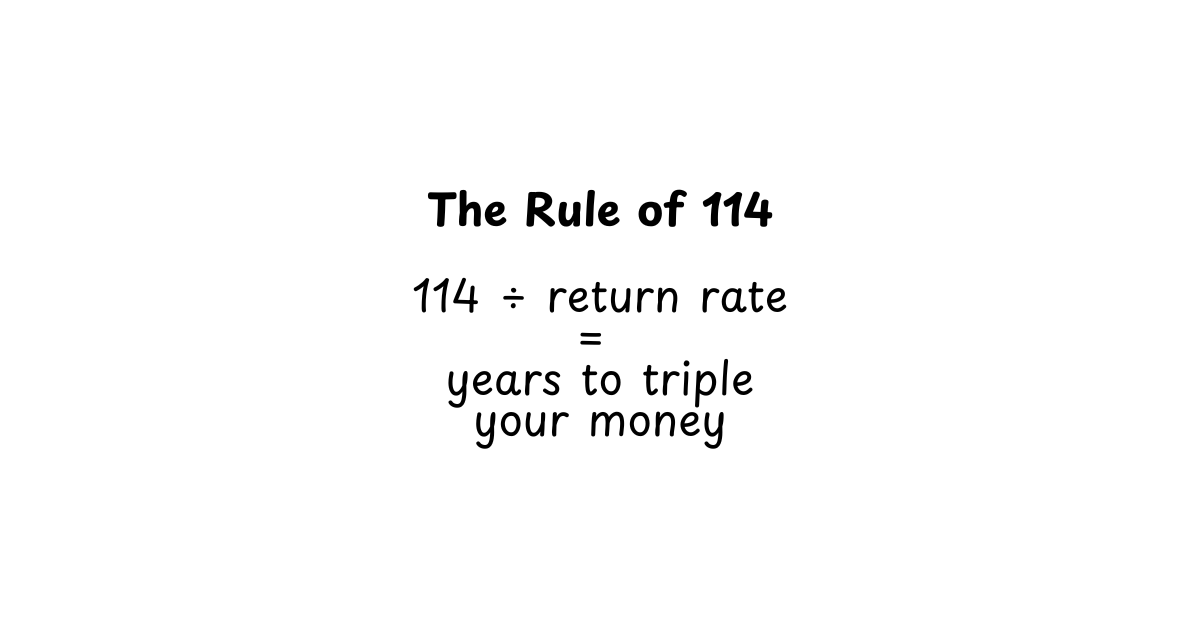
2. The rule of 114: how long does it take to triple your money?
What it means: The Rule of 114 tells you how long it will take to triple your money instead of doubling it. Simply divide 114 by your expected annual return.
Example:
- At a 7% return, your money triples in 16.3 years (114 ÷ 7).
- At a 10% return, your money triples in 11.4 years (114 ÷ 10).
This rule is useful for long-term wealth planning. If your goal is to 3x your wealth before retirement, this helps set realistic expectations.
Caveats: Like the Rule of 72, it doesn’t account for economic downturns, inflation, or taxation.
3. The Rule of 144
What it means: We've already looked at doubling and tripling investments. But what about quadrupling? The Rule of 144 is a lesser-known compounding rule that helps us with just that. Simply divide 144 by the interest rate.
Example:
- At a 6% return, money quadruples in 24 years (144 ÷ 6).
- At a 10% return, money quadruples in 14.4 years (144 ÷ 10).
This is a useful long-term wealth projection tool. It rewards those who stick to the 3 behaviors all successful investors need: time, patience and discipline. Many people invest for 5-10 years and are disappointed with the results. But those who stay invested for 20+ years, often see life-changing growth.
Caveats: Like other compounding rules, it assumes steady returns.
4. The rule of 70: how fast does inflation halve the value of cash?
What it means: The Rule of 70 estimates how long inflation will take to halve the purchasing power of money. Simply divide 70 by the annual inflation rate.
Example:
- If inflation is 3%, money loses half its value in 23.3 years (70 ÷ 3).
- If inflation is 4%, money loses half its value in 17.5 years (70 ÷ 4).
Or to put it another way:
- At 3% inflation, $100 today will buy only $50 worth of goods in 23.3 years.
- At 4% inflation, $100,000 in cash saved today will have the purchasing power of only $50,000 in 17.5 years.
Inflation silently erodes wealth and damages your future purchasing power and ultimately, your life opportunities. Money languishing in cash or in low interest accounts is slowly and steadily being eating away, every day, by termites.
Caveats: Inflation rates fluctuate and can spike unexpectedly (as seen in recent years).
Money rules for investing
Two rules give a rough answer to the questions every investor asks first: how much risk to take, and what return to expect for it.
5. The 120-minus-age rule: how much of your portfolio should be in equities?
What it means: The 120-minus-age rule is a general guideline for asset allocation between stocks and bonds. It suggests subtracting your age from 120 to give the percentage of your portfolio to hold in equities.
Example:
- If you're 50, the rule suggests 70% of your portfolio in equities, and the rest in safer assets like bonds (120 - 50).
- If you're 30, the rule suggests 90% in equities (120 - 30).
This is a useful tool to help you remain diversified throughout your investing life and a simple formula to balance risk and reward.
Caveats: While your investment allocation should change with age, this isn't all you should consider: market conditions and personal risk tolerance should also factor in. The rule also doesn't apply for wealthier families who can use a more optimal system of structuring their affairs with a well-sized 'war chest' of bonds to get them through periods of volatility to maximise the growth of their 'family fortress' held in equities.
6. The 10-5-3 rule: what return can you expect from each asset class?
What it means: The 10-5-3 rule gives a rough estimate of long-term returns from different asset classes. Remember it this way.
You can expect a:
- 10% return from equities (historically)
- 5% from bonds
- 3% from cash deposits
Example:
- If you invest $500,000 in equities, you can roughly expect $50,000 in returns per year.
- If you keep $500,000 in cash, you can roughly expect $15,000 in returns per year.
This rule helps set realistic expectations based on how you choose to invest or hold your money. The difference between the expected returns compounds over the years to create huge differences. It also highlights potential red flags (if someone promises 20% guaranteed returns, run in the opposite direction).
Caveats: Market fluctuations mean no return is truly guaranteed. Remember that these are long-term averages before inflation. Whilst cash may feel safe, inflation tends to entirely erode the value of cash holdings. Any specific year or even decade can vary significantly from these long-term averages.
Money rules for spending, retirement and protecting your family
The last three rules, and the bonus, deal with what the money is for. How much to spend, how much to draw, and what happens to the people who depend on you.
7. The 50/30/20 rule
What it means: The 50/30/20 rule is a simple budgeting rule to help manage income effectively.
It suggests allocating:
- 50% of income to needs (housing, bills, essentials)
- 30% to wants (travel, entertainment, luxury items)
- 20% to savings and investments
Example:
If you earn $1,000,000 a year, the breakdown would look like this:
- $500,000 for necessities (mortgage, household expenses, insurance)
- $300,000 for lifestyle choices (holidays, fine dining, hobbies)
- $200,000 into savings, pensions, or investments
Why does this rule work so well?
It fights our natural "present bias" - our tendency to prioritise immediate rewards over future benefits.
By dedicating a specific portion to saving, you're making your future security non-negotiable. If you aren’t already tracking your spending, do it for a month and see how close you are to this split, and adjust as needed.
Caveats: The rule is great for general financial discipline, but may not apply to high-net-worth individuals, where investment allocations might be far higher than 20%.
If this sounds like you, try flipping the rule on it's head, and see what this does to your results:
- 50% on investing
- 30% on needs
- 20% on wants
8. The 4% withdrawal rule: how much can you take from your portfolio each year?
What it means: This retirement rule of thumb suggests that withdrawing 4% annually (adjusted each year for inflation) from a portfolio should make savings last at least 30 years.
It also gives you a clear target for how much money you need to retire comfortably.
There are two ways to look at it:
- Use it work out how much you can withdraw per year (retirement pot x 4%)
- Use it to work out how much you will need to save for retirement (simply divide your desired annual retirement income by 0.04, or multiply by 25).
Example:
- If you retire with $5 million, you could withdraw $200,000 per year under this rule
- If you need $100,000 yearly in retirement, you'll need $2,500,000 (100,000 ÷ 0.04)
- If you need $80,000 per year in retirement, you'll need $2,000,000 (80,000 x 25)
A survey by Fidelity found that people who follow the 4% withdrawal rule are more likely to achieve their retirement goals.
Caveats: This rule works best with a diversified portfolio. Market downturns can impact withdrawals, so flexibility is key. This rule originated from the "Trinity Study" in the 1990s and has been refined over time. Some financial planners now recommend a more conservative 3-3.5% withdrawal rate, especially for early retirees. As ever, it depends on current economic conditions. Read more about this rule from Amazon best-selling author Andrew Hallam.
9. The 10-15X income life insurance rule: how much life insurance do you need?
What it means: According to the 10-15x income rule, your life insurance cover should be worth 10-15 times your annual income to protect dependents. This is especially important for senior international professionals who have others depending on their income.
Example:
- If you earn $500,000 annually, you should have $5-7.5 million in life insurance.
- If you earn $1,000,000 annually, you should have $10-15 million in life insurance.
High-net-worth individuals often have complex financial commitments, from mortgages on multiple properties to private school fees, long-term investments, and business ownership stakes. A well-structured life insurance policy ensures your family doesn’t face a financial crisis in the event of your passing, allowing them to maintain their lifestyle and manage inherited assets effectively.
So, review your policies to ensure proper coverage, considering factors like inflation, existing assets, and estate taxes to ensure adequate coverage.
Caveats: Personal circumstances (debts, lifestyle, investments) may mean you need more or less than the standard guideline. It's worth having a Financial Life Manager assess your specific needs.
Bonus: The 10/10/10 Rule
What it means: This is an excellent decision-making framework which helps you consider how a financial decision will impact you in 10 minutes, 10 months, and 10 years.
Example:
You want to buy a brand new, luxury car. Before committing, ask yourself:
- Will this purchase matter 10 minutes from now? (immedaite satisfaction)
- Will this purchase matter 10 months from now? (whether it still fits your plans once the novelty wears off)
- Will this purchase matter a decade from now? (long term consequences of this decision)
This rule helps curb impulsive spending and highlights the importance of delayed gratification, helping you break down your thoughts into short-term, mid-term, and long-term perspectives. It's also a great one to teach to children.
Caveats: It doesn’t work well for urgent decisions.
Why money rules for the wealthy need different numbers
Every rule in this list answers one question at a time. How fast will this grow? How much can I spend? How much cover do I need?
Once you've built significant wealth, the questions arrive together. And the rules start to disagree with each other.
The 120-minus-age rule would put £4 million of a 60-year-old's £10 million portfolio into bonds. Much of that money may never be spent in their lifetime. A family in that position can hold a war chest of bonds and cash for the next few years of spending. The rest can stay in equities as a family fortress for the long term.
The 4% rule asks how much you can take without running out. If running out isn't a realistic risk, the better question is what the money is for, and who it's for after you.
The life insurance multiple ignores what you already own, which country will tax your estate, and how it will pass on. For an internationally mobile family, those questions can matter more than the size of the policy.
Each of these rules answers its own question well. The trouble starts when they're applied one at a time to a life that doesn't arrive one question at a time.
That's the gap AES built Financial Life Management to close. Financial Life Management focuses on helping you make better decisions about your life, not just managing your money. Three things have to align: your purpose, your plan, and your portfolio.
The rules of thumb still have a place inside that plan. They just don't get to run it.
Where this leaves you
Money rules like these aren’t just theoretical - they can be powerful tools for guiding financial decisions.
While no single rule is perfect, understanding these principles can help you grow and preserve wealth in a structured way.
The key?
Apply them wisely, adapt them to your own situation, and always consider the bigger picture.
If you'd like to talk through which of these money rules fit your own plan, book a 15-minute discovery call.